Address
304 North Cardinal St.
Dorchester Center, MA 02124
Work Hours
Monday to Friday: 7AM - 7PM
Weekend: 10AM - 5PM
Address
304 North Cardinal St.
Dorchester Center, MA 02124
Work Hours
Monday to Friday: 7AM - 7PM
Weekend: 10AM - 5PM


Artificial intelligence is evolving from a tool that merely answers questions into systems that act on our behalf. At the heart of this transition are AI Agents — autonomous, adaptive programs that can perceive their environment, make decisions, and execute actions to achieve goals. Unlike traditional software that executes static rules, AI Agents can learn, adapt, and collaborate, making them one of the most important developments in modern technology.
In this article, we will unpack AI Agents in detail: how they work, what they’re made of, the types that exist, how businesses are using them, and why structured data is their fuel.
At a conceptual level, AI Agents operate through a continuous cycle of perception, reasoning, and action. They gather information from their environment, interpret what they see, decide on a course of action, and then execute it. Crucially, this loop is ongoing, allowing the agent to adapt as conditions change.
Imagine a logistics agent tasked with coordinating deliveries. It must interpret live traffic data, compare it with schedules, and evaluate alternative routes. If a traffic accident blocks the road, the agent doesn’t wait for a human—it recalculates in real time. As we discussed in how AI agents use entity data, this ability to reason relies heavily on structured information.
What separates AI Agents from older automation is their ability to handle uncertainty. A scripted system responds to triggers; an AI agent parses unstructured data and infers meaning.
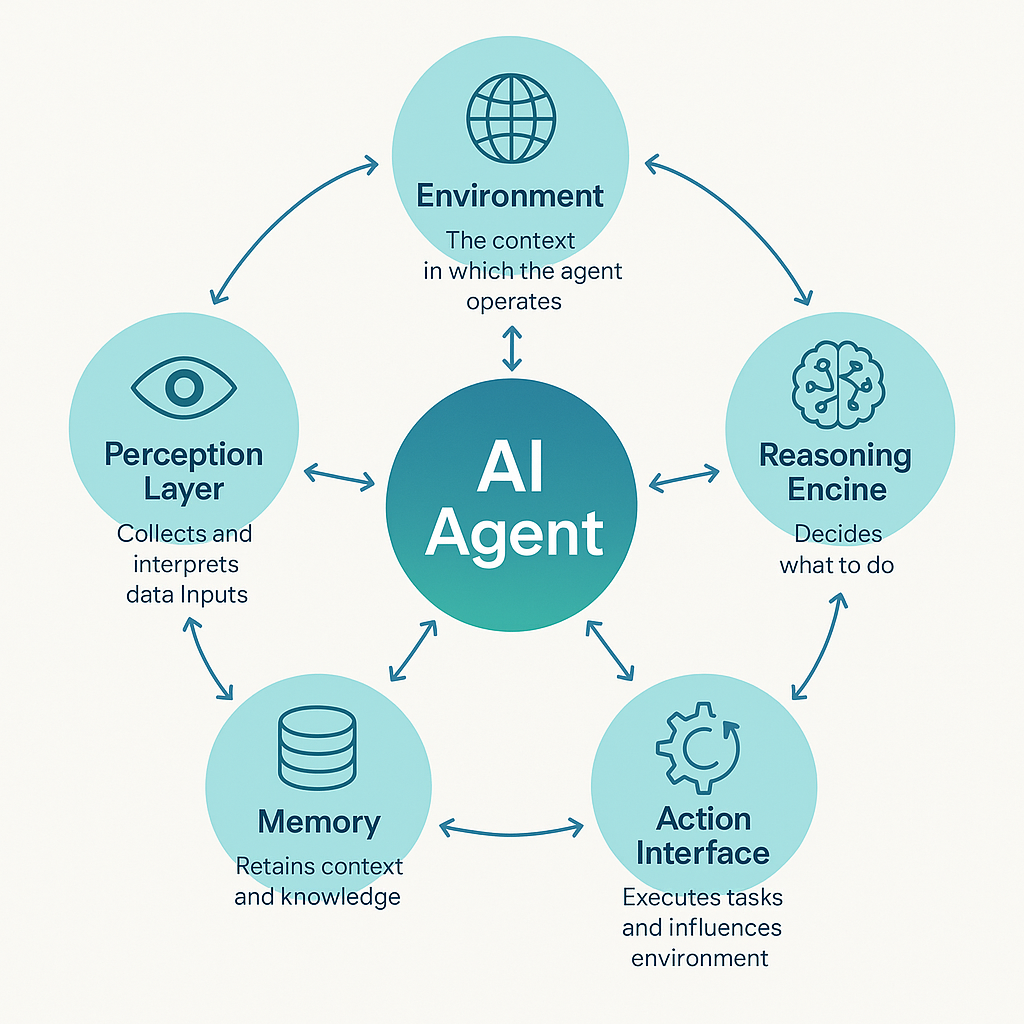
AI Agents are built from interconnected components that mirror aspects of human cognition:
1. The Environment: Every agent exists within a defined environment—a digital platform or the physical world—that sets the boundaries for observation.
2. Perception Layer: This is the agent’s sensory system. It collects raw data and translates it into structured input.
3. Reasoning Engine: The core of the agent. This may involve algorithms or Reinforcement Learning. The reasoning engine evaluates alternatives and chooses the best path.
4. Memory: Agents require memory to track context. As noted in our guide to Clean Knowledge Architecture, a stable memory structure is essential for agents to learn from history.
5. Action Interface: This is how the agent affects its environment, such as sending an email or triggering a robotic movement.
AI Agents are not restricted to a single function. They can be designed for transactional tasks (like those in Generative Commerce), analytical tasks, or interactive tasks. Some are generalists, while others are specialists.
Take customer service: A chatbot recognizes keywords. An AI agent interprets a vague complaint, checks the system, and guides the customer step by step without human intervention.
AI researchers classify agents based on their sophistication:
Large Language Models (LLMs) have supercharged AI Agents by giving them the ability to reason with natural language. However, an LLM is not an agent by default. It becomes an agent when coupled with memory, tools, and the ability to act.
Organizations adopt agents in different ways. Some use plug-and-play agents in SaaS platforms, while others build custom agents tailored to proprietary data. The most ambitious enterprises build agent ecosystems where specialized agents collaborate to achieve complex goals.
Across industries, AI Agents are shifting from pilots to production:
The unifying theme is clear: AI Agents introduce efficiency and adaptability that reshapes how organizations operate.
AI Agents are more than a buzzword. They represent a profound shift from systems that wait for input to systems that act on our behalf. For innovators, the question is no longer “What are they?” but “How quickly can we adopt them?”
Not exactly. A chatbot is typically designed to handle conversations within a limited scope, often relying on scripted responses or predefined flows. An AI agent, on the other hand, is a broader system that not only converses but also perceives, reasons, and takes action within its environment. A chatbot may tell you the status of your order; an AI agent can actually check the warehouse system, reroute a delayed shipment, and notify you of the updated delivery time.
AI agents are best understood as augmenters of human capability, not one-to-one replacements. They excel at repetitive, time-consuming, and data-heavy tasks, freeing employees to focus on judgment, creativity, and human relationships. For instance, in financial services, an AI agent may generate daily risk reports automatically, but it is still human analysts who interpret those findings and make strategic decisions. While some routine roles may shrink, the broader trend is toward job transformation rather than wholesale elimination.
An algorithm is a set of rules or instructions designed to perform a specific task. An AI agent, however, is a <strong>system that uses algorithms (often multiple types) in combination with perception, memory, and action interfaces</strong> to achieve goals autonomously. In simple terms, algorithms are building blocks; agents are the architects that use those blocks dynamically to pursue objectives.
Learning agents rely on a feedback loop. They observe outcomes from their actions, compare those outcomes to desired goals, and adjust future behavior accordingly. Some rely on reinforcement learning, where they are rewarded for successful outcomes. Others leverage large language models connected to memory systems, enabling them to accumulate knowledge across interactions. The key is that agents don’t remain static — their performance can improve with experience, much like a human employee who grows more skilled with practice.
AI agents are becoming increasingly accessible. While early adoption was concentrated in big tech firms and Fortune 500 companies, the rise of plug-and-play platforms and open-source frameworks means smaller organizations can also deploy agents. For example, a mid-sized e-commerce business could use an AI agent to handle product recommendations, manage customer queries, and optimize advertising campaigns functions that previously required dedicated teams.
The main risks involve <strong>data governance, reliability, and ethics</strong>. Agents that access sensitive data must operate within strict privacy and compliance frameworks. Because some rely on generative models, they may occasionally produce incorrect or misleading outputs, making human oversight critical. And finally, organizations must be vigilant about fairness and bias, ensuring that agents do not perpetuate or amplify inequities present in the training data.
The trajectory points toward multi-agent ecosystems networks of specialized agents that collaborate and even negotiate with each other. Imagine a supply chain where one agent manages procurement, another oversees transportation, and a third monitors regulatory compliance, all coordinating in real time without direct human supervision. Combined with advances in robotics, this will extend AI agents beyond the digital realm and into the physical world, where they can influence manufacturing floors, healthcare delivery, and urban infrastructure.
